The FAR Audit Process
The FAR audit process examines whether a contractor’s accounting system, cost structures, internal controls, and billing practices comply with Federal Acquisition Regulation (FAR) Part 31, Cost Accounting Standards (CAS) (when applicable), and any agency-specific requirements. Although audits vary slightly depending on the contract type and the requesting agency (often DCAA or DCMA), the process generally follows a structured sequence of phases supported by extensive documentation.
Planning and Risk Assessment
The audit process begins with a review of information about the contractor and assessing risks that could lead to unallowable, unreasonable, or misallocated costs. This sets the scope and objectives of the audit.
The typical documentation requested in this phase includes the organizational chart, chart of accounting, accounting policies and procedures, list of major cost pools, indirect rate structure descriptions, prior audit report, contract list with contract types, internal control documentation including segregation of duties, timekeeping and labor charging. During this phase, the audit firm evaluates whether the accounting system is capable of segregating direct/indirect costs, excluding unallowable costs, and producing reliable reporting.
Fieldwork
This is the core of a FAR audit. Auditors perform testing to determine whether the contractor’s financial systems and cost practices comply with FAR and CAS. The testing focuses on allocability, allowability, reasonableness, and consistency. Auditors will typically collect documentation in several areas including indirect costs and pools, direct costs, unallowable cost controls, billing and incurred cost reporting and internal control evidence. During this time classification accuracy will be verified, misallocation tested sample expenses collected for allowability, and confirmation that indirect rates have been applied consistently.
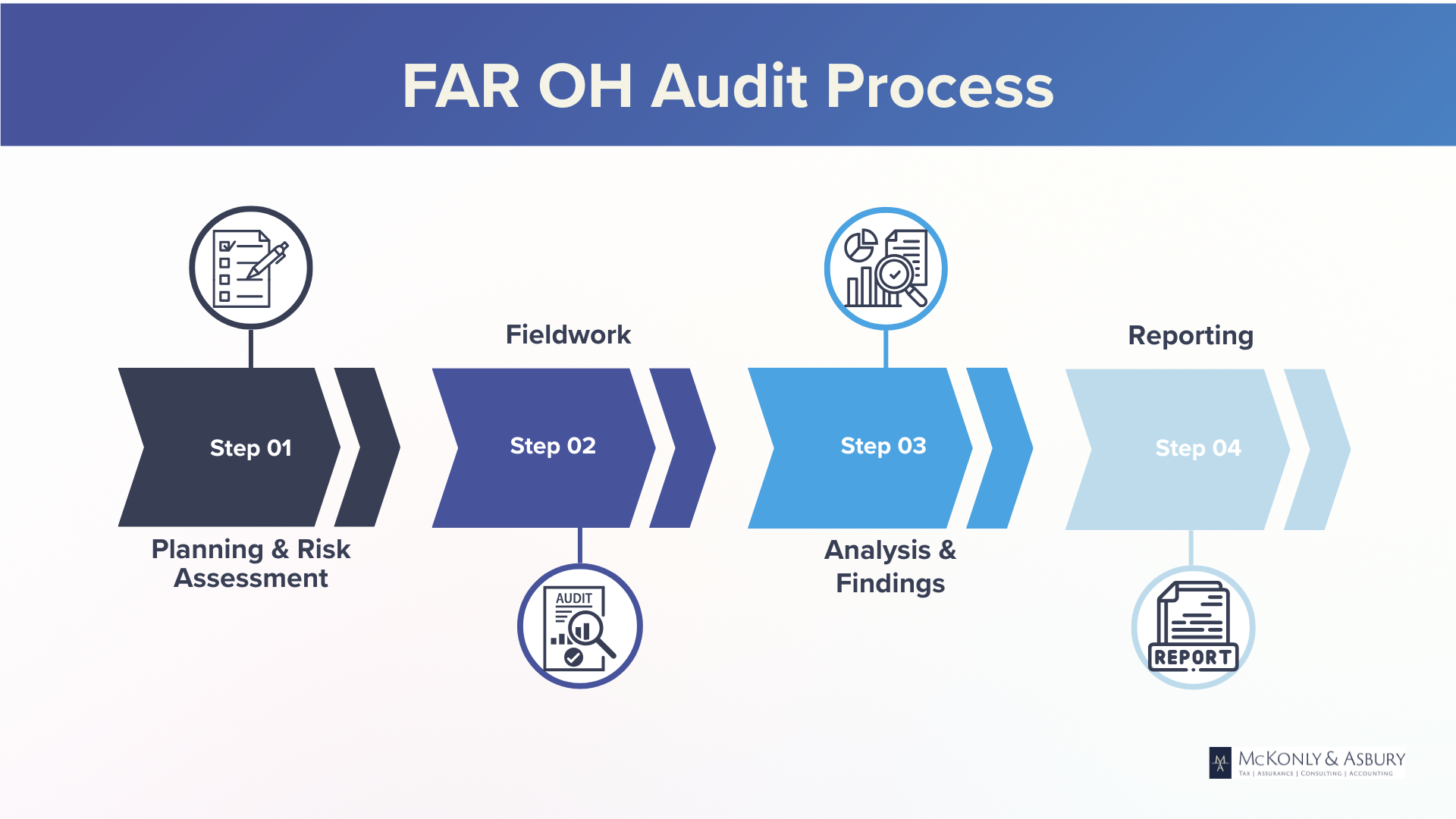
Analysis and Findings
After fieldwork, auditors evaluate variances, identify questioned costs, and determine whether any business systems are deficient. During this stage, the documentation reviewed usually includes corrective actions taken for system weaknesses, responses to inquiries, revised cost pool schedules or indirect rate calculations, and additional information on unsupported transactions.
The auditors will also reconcile costs to financial statements, check rate calculations, and ensure the contractor has followed proper CAS/FAR guidelines. High-risk areas—such as labor charging, subcontract management, and executive compensation—often receive deeper review.
Reporting
The auditors issue a formal audit report summarizing findings, questioned costs, system deficiencies, and recommendations. This report is often sent to the contracting officer, who uses it to negotiate final indirect rates or determine further actions.
Types of FAR-Related Audits
The Federal Acquisition Regulation (FAR) governs how the U.S. government acquires goods and services, and compliance often involves various types of audits, particularly for contractors seeking cost reimbursement. A list of the most common types of FAR audits are listed below.
- Overhead Rate Audits – This is commonly referred to as a FAR audit, and it is designed to determine if a contractor’s indirect cost rate is calculated properly according to FAR Part 31. The focus of this audit is reviewing the contractor’s accounting system and internal controls, test indirect expenses for unallowable costs, test payroll and timesheets to verify the proper allocation of costs through the job cost system. The key framework used for this audit is the American Association of State Highway and Transportation Officials (AASHTO) audit guide. A FAR audit is typically required for architectural and engineering firms working on federal or state funded projects.
- Accounting System Audit – This is a pre-award or post-award review to ensure the contractor’s financial system is suitable to support government contracts, specifically cost reimbursement contracts. The requirements are outlined in FAR 52.232-20 and the DCAA’s Audit Manual. The key areas reviewed include cost segregation, timekeeping, job costing, invoicing, unallowable costs, and systems interface. Any contractor that has an accounting system that is deemed inadequate can face contract withholding or be prohibited from bidding on certain contract types.
- Estimating Systems Audit – This audit is triggered when a contractor submits a proposal that required Certified Cost or Pricing Data (CCPD). It ensures the methods used to forecast contract costs are reliable, accurate, and properly applied. The requirements are outlined in FAR 15.407.-5. The key areas reviewed include data reliability, consistency, documentation, reasonableness, system control, and Truth in Negotiations Act (TINA) An approved estimating system allows contractors to submit proposals with more confidence and often speeds up the government’s proposal review process.
- Compliance Audits – These audits are designed to review adherence to the specific terms and conditions in the contracts. The key areas evaluated include contract clauses, billing/invoicing, and system integrity. A key part of these audits is determining compliance with Cost Accounting Standards which appear in 48 CFR Chapter 99. These are detailed rules that contractors must follow for measuring, assigning, and allocating costs. There are two requirements for CAS covered contractors, including consistency with the rules and completing of disclosure statement (DS-1).
- Provisional Billing Rate Audits – This audit is designed to determine and approve a reasonable set of indirect rates which can be used to bill the government until the actual annual rates are finalized. This ensures the government is not over or underpaying during the contract. The auditor examines the reasonableness of the forecasted direct labor base and indirect cost pools, identifies whether the estimates properly exclude unallowable costs, and compares the proposed and historical ensuring estimates are realistic. These audits establish interim rates while the Overhead Rate Audit establishes the final rates.
- Forward Pricing Audits – This audit is generally conducted by the DCAA to evaluate cost estimates used by a contract is a specific, single proposal, for a future contract or contract modification. The focus is on the reasonableness and support for the proposed costs which will be incurred in the future. The areas examined include labor, materials, indirect, and subcontractor costs. Attention is also paid to the use of systems including the estimating system. A successful Forward Pricing Audit provides the contractor with confidence in the proposed cost elements which means a faster negotiation and award process.
- Business System Audits – The audit focuses on the contractor’s internal control environment and management systems to ensure reliability and effectiveness. They also ensure compliance with government requirements for properly tracking costs, materials, and compliance data. It is triggered by DFARS clauses 252.242.-7005 which permits payment to be withheld if a system is deemed significantly deficient. The key business systems reviewed include accounting, estimating, earned value management, material management and accounting, property management and the purchasing system. There is high risk in these audits because if the DCAA finds a significant deficiency they can not only withhold payments they can also disallow contract costs.
FAR Audit Findings: Common Issues
The most common findings uncovered during a FAR audit are related to compliance and generally center on a contractor’s accounting practices and internal controls.
Cost Related Deficiencies
These are related to how contractors classify, record, and claim costs on government contracts. The most common are charging unallowable costs, improper cost allocation, and inadequate documentation.
- Charging Unallowable Costs – This happens when expenses not allowed by FAR Part 31 (including entertainment, lobbying, or advertising costs) are included in billings or indirect rate submissions.
- Improper Cost Allocation – This happens when the contractor fails to correctly allocate certain costs as direct versus indirect to all contracts. This finding may also be used when there is inconsistent charging of the same type of cost.
- Insufficient Documentation – This happens when a contractor has insufficient supporting records to verify the allowability, allocability, and reasonableness of claimed costs.
Labor and Timekeeping Issues
- Inconsistent Timekeeping – This happens when employees fail to accurately record time worked or supervisors do not properly review submitted timesheets. This practice undermines the accuracy of labor costs charged to the government.
- Lack of Total Time Reporting – This happens when there is a failure to record all hours worked by employees even those not charged to a specific contract.
- Inaccurate Timesheet Updates – This happens when a supervisor or administration corrects or alters an employee’s timesheet without the worker’s knowledge or signature/approval.
Documentation & Policy Deficiencies
- Inadequate Documentation – This happens when missing or incomplete documentation (invoices, approval forms) to substantiate the necessity and amount of a cost is found.
- Missing/Outdated Policies – This finding occurs when an auditor discovers that policies and procedures are not documented in writing or updated leaving them out of compliance with DFARS requirements.
- Failure to Follow Policies – Even when written policies do exist, occasionally employees fail to consistently follow required internal controls leading to compliance issues.
Incurred Cost Submission (ICS) and Rates
- Late or Incomplete ICS – This finding occurs when the contractor fails to submit the annual Incurred Cost Submission with the required six-month period after the contractor’s fiscal year-end.
- Inaccurate Provisional Billing Rates – Using estimated indirect billing rates that are very different from the actual costs can lead to over or under billing.
- Lack of Reconciliation – This finding occurs when there is a failure to reconcile the costs claimed in the ICS and final billings back to the general ledger and related records.
Preparing for a Successful FAR Audit
Preparation is an ongoing, proactive process that ensures the contractor’s accounting system and internal controls are robust and compliant.
Understand FAR and AASHTO Guidelines
Become familiar with FAR Part 31, which outlines the criteria for allowable costs, and the , which provides detailed guidance for calculating overhead rates. The AASHTO Audit Guide should be a “go-to” tool that contains nearly anything and everything related to overhead rate calculations and audit.
Internal Readiness Assessments
Contractors should consider conducting a comprehensive internal or hiring an external consultant specializing in DCAA to conduct a mock audit. The focus should be high risk areas like Incurred Cost Submissions (ICS), timekeeping, and travel expenses. Time should also be spent comparing current policies and practices against the requirements of FAR Part 31 and SF 1408 (Pre-Award Survey) checklist. Finally, run reports and trace transactions through the accounting system to final billings to ensure there is a clean audit trail.
Accounting System Requirements
Contractors must use an accounting system that meets minimum standards based on DCAA and other requirements. It is essential to review systems to ensure they can properly segregate costs. This means it should be able to distinguish between direct, indirect, and unallowable costs. Job costing functionality should permit accumulated costs to be tracked by contract, task, or Contract Line-Item Number (CLIN). There should also be the ability to reconcile job cost ledgers to the general ledger.
While the DCAA does not approve or certify a specific accounting product it is ideal to use accounting software specifically designed for government contractors such as Deltek, Unanet, etc.. Many of these programs have built-in functionality including indirect cost pool calculations, labor distribution based on timesheets, and unallowable cost tracking.

Policies, Procedures and Internal Controls
It is important to have written documentation because auditors rely on this information when evaluating whether what is documented is actually followed. For this reason, it is important to have formal manuals that include a set of written policies and procedures that govern all financial activities. This should include timekeeping, purchasing, expense reporting and subcontracts. There should also be documented internal controls designed to prevent and detect misstatements and errors. Be sure there is appropriate segregation of duties and various levels of authorization. Finally ensure every policy specifically refers to and aligns with relevant FAR or DFAR clauses.
Timesheet and Labor Charging Best Practices
Since labor is the number one audit risk, contractors should maintain strict controls and ensure they are consistently applied. This includes daily time entry, total time accounting, supervisory review, and training and certification. For daily time entry the contractors must enforce a strict policy requiring daily recording of hours worked by all employees. The system must also capture all hours worked by each employee to avoid distortion of labor rates. Supervisors must knowingly approve all worked performed and not just rubber stamp time sheets. Finally, the contractors should provide regular training to all employees on the proper coding and certification of timesheets.
Record Retention and Compliance Documentation
Ensuring that records are organized and documentation complete is essential to a quick and successful audit. For this reason, it is important for contractors to have an established record retention policy. This should contain information on how long specific records (invoices, timesheets, etc.) must be retained in accordance with FAR 4.703 which often requires three years after final contract payment. Files should be organized and easy to access. Separate files should be maintained for the Disclosure Statement (DS-1), all indirect cost rate proposals and DCAA audit reports, and internal audit reports and Corrective Action Plans.
FAR Audit Outcomes
A FAR audit can have various outcomes which impact a contractor’s financial situation and future ability to win new government work. The audit findings are included in the final audit report delivered to the government’s contracting officer (CO) who makes a final determination. The most common outcomes are listed below and include favorable, unfavorable, and disputed.
Favorable Outcomes
- Unmodified Opinion – For reviews of an entire system, such as an Accounting System or Estimating System, this is the optimal result. In essence, an unmodified opinion means the system is considered adequate and in compliance with FAR criteria.
- No Significant Findings – This outcome means there may have been minor issues the contractor can address easily, most times without a formal Corrective Action Plan (CAP) as mandated by the CO.
- Final Indirect Rate Settlement – For incurred cost audits, a successful outcome is the final negotiation and agreement of the contractor’s actual indirect cost rates for the audited fiscal year, formally closing out the costs for that period.
Unfavorable Outcomes
- Questioned Costs –In this case, the auditor identifies specific costs that are deemed unallowable and recommended they be disallowed. Examples may include entertainment, lobbying, or other inadequately supported costs. The CO will review the contractor’s response to questioned costs and make a final decision about whether repayment is required.
- Defective Pricing – For audits subjected to Truth in Negotiations Act (TINA) requirements, the auditor can find the contractor submitted inaccurate, incomplete, or non-current data. In this case, the government may implement a price reduction on the contract, and the contractor could be subject to penalties in addition to the overcharged amount.
- 100% Penalty – For certain specifically unallowable costs (like costs for alcoholic beverages or corporate advertising) included in an incurred cost proposal, the contractor may be subject to a 100% penalty on top of the cost disallowance.
Disputed Outcomes
The outcome of an audit may result in follow-up and negotiation. The final outcome is determined by the Contracting Officer’s Final Decision (COFD) which formalizes the government’s position on findings and any adjustments. This can result in an agreement on all issues and a determination of a final rate settlement. There may also be a binding decision on costs or system adequacy that the contractor must satisfy to make an appeal.
In the event of appeal, the outcome is elevated into the formal dispute resolution process, which generally means appealing to the Board of Contract Appeals or the US Court of Federal Claims. It is important to note; repeated audit failures can have an adverse impact on a contractor’s reputation and lead to the loss of future contracts or a lower competitive standing.
Contact Our FAR Audit Team