Acquisition Planning: 3 Key Considerations That Are Easily Missed
Key Takeaways
- Plan for Acquired Jobs: Establish a clear method for integrating acquired projects into the accounting system and WIP schedule, particularly when overbillings or underbillings exist at acquisition.
- Understand Job Costing Differences: Differences in overhead application and job cost composition between the acquiree and acquirer can significantly impact project profitability assessments.
- Address Warranty and Rework Risk: Clearly define responsibility for prospective warranty and rework costs in the acquisition documents to help protect the acquirer from unexpected expenses.
- Prepare Before Closing: Proactively addressing accounting, job costing, and post-acquisition responsibilities can help position the business for a smoother transition and stronger performance after the acquisition.
An acquisition can be a very effective method for those looking to grow their business, expanding their geographic footprint, or diversifying their service line. However, expansive contract provisions and high stakes negotiations make the acquisition process a very wide-ranging and complex endeavor. Here are three critical, but often overlooked, matters to consider when preparing for an acquisition.
1. System Setup for Acquired In-Process Jobs
Accounting systems are designed to facilitate the tracking of contracts from start to finish. As a result, determining how to accurately set up and account for acquired jobs within a business’s accounting system can be a challenging feat. This is especially the case for jobs that have overbillings or underbillings at the time of the acquisition. Given these difficulties, it is prudent to identify a method early on that will enable the successful integration of acquired projects into one’s WIP schedule and accounting system.
When determining the appropriate contract value at which to present acquired projects on a WIP schedule, it is important to determine the amount of revenue that the acquirer has the Opportunity to Earn, from the time of the acquisition through the completion of the project. This can be expressed using the following formula:
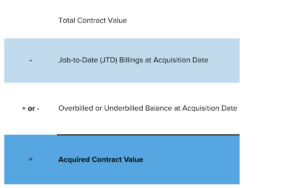
Thus, if an acquired contract has a total value of $1,000,000, as well as JTD Billings and an overbilled balance of $200,000 and $100,000, respectively, at the acquisition date, the contract value from the acquirer’s perspective would be $900,000. This is calculated as follows:
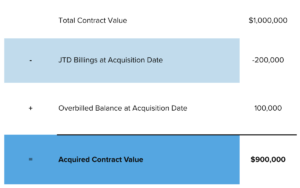
While the best way for accomplishing this may vary from system to system, it may be helpful to set things up in two stages within the accounting software: 1) A master project that captures the contract as a whole to maintain continuity of billing from the end customer’s perspective, and 2) an internal sub-project, expressed using negative values, that captures the activity performed by the acquiree through the acquisition date. The net result of the master project and the sub-project will then reflect the contract values and performance from the acquirer’s perspective.
2. Composition of Job Costs Presented on the Acquiree’s WIP Schedule
Methods for overhead application, as well as the general makeup of items recorded to job costs, can vary significantly from contractor to contractor. When assessing the acquiree’s WIP, it is essential to understand the acquiree’s approach to these items. Their approach might be vastly different from the acquirer’s and can profoundly impact conclusions regarding the profitability of their projects.
3. Responsibility for Prospective Warranty and Rework on Acquired Projects
The potential for prospective rework and warranty work on acquired jobs is a high-risk variable. These factors can single-handedly compromise the performance of the acquired projects, as well as the overall profitability of the acquiring company. Within the acquisition documents, it is thus critical to clearly define which party has responsibility for these items, as well as contractual remedies for resolving any issues that arise post-acquisition.
Proactive navigation of each of these items will help a business position their team for success after the acquisition closes.
For more information about McKonly & Asbury’s Architecture, Engineering, and Construction (AEC) experience, visit the AEC Industry Page and don’t hesitate to contact a member of the AEC team.
About the Author

Tim Showers, CPA is a leader within our Architecture, Engineering, and Construction (AEC) practice, serving clients across the Mid-Atlantic.… Read more