Waste Not: Solutions for Food Supply Chain Losses
Whether you’re a farmer experiencing price volatility, a food manufacturer facing a less reliable supply chain, a grocery store responding to customers’ ever-rising expectations on what “fresh” looks like, or a household consumer still recovering from a challenging inflationary environment, one thing is clear – food waste is a problem that one cannot afford to ignore. While not a new challenge, mitigating waste has steadily risen over time to become one of the more important issues faced by food businesses. This article will review key statistics that summarize the scope of the issue and explore several practical solutions that businesses are implementing to meaningfully reduce food waste.
Summary of Food Waste
Food waste is not a controversial topic, as nobody is pro-food waste. Generation after generation is taught to not waste food, and yet through the first quarter of the 21st century food is continuously discarded at alarming rates. In 2024, over 70 million tons of surplus food were generated in the United States, nearly half of which was produce. While a small percentage of the surplus food is donated (2.4%) or recycled (9.4%), 88.2% ultimately goes to waste. As a result, food accounts for 24% of what goes into our landfills. For U.S. food producers and businesses, excess food represents an estimated $108 billion in lost revenue each year.
Although it is easy to assume that most waste occurs at the household level, food waste is relatively evenly distributed across the supply chain. Farms, manufacturers, retailers, and end consumers all contribute significantly to the food waste supply chain, as shown in the graph from ReFED below.
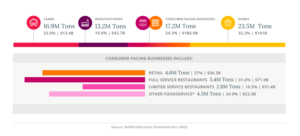
Graph of food waste contributions by ReFED
Exploring Solutions
Organizations that treat food waste as an opportunity — rather than simply a sustainability issue — are the ones that tend to achieve measurable, lasting results. Below are three practical solutions that businesses across the food supply chain are successfully implementing today.
1. Measure Inventory Shrink and Report It Consistently
This goes to the heart of the adage; “what gets measured gets managed.” While measuring shrink does not solve the problem, it creates accountability and visibility. Including inventory shrink in the monthly reporting package ensures that everyone from the plant floor to procurement to accounting understands the financial impact of waste each period. Over time, consistent measurement allows management to identify trends, uncover root causes, and implement process improvements that reduce preventable losses.
2. Introduce Dynamic Pricing to Reduce Expiration Losses
Dynamic pricing can help move less desirable products or those that are nearing their best-by dates. Platforms such as Too Good To Go and Flashfood allow consumers to purchase these items at a reduced price, creating an incentive to buy products that might otherwise go unsold. The result is less waste going into landfills, less inventory write-offs, and a lower grocery bill. In other words, this is a win-win-win for the planet, retailers, and households.
3. Invest in Equipment and Technology to Extend Shelf Life
Strategic capital investment can meaningfully reduce spoilage. One recent example in Central Pennsylvania is Sunrise Logistics’ investment in their high-pressure processing machine, which uses up to 87,000 psi to extend the shelf life of food and beverages without using heat or adding preservatives. Technological solutions like this can enhance product quality, improve distribution flexibility, and reduce waste at scale.
Final Thoughts
Reducing waste does not require sweeping transformation; it requires discipline, visibility, and targeted investment. Food waste is not merely an environmental issue; it is also an operational, financial, and strategic issue. We have found that organizations that care enough to create goals around reducing waste, measure shrink, and then hold teams accountable for improvement are far more likely to be successful in reducing food waste. Consider what impact reduced shrink would have on your profit margins, and what you would be willing to invest, both in terms of time and money, in order to achieve those margins.
Please reach out to a member of our Manufacturing & Distribution team for more information on the topic outlined above. For more information regarding our Manufacturing & Distribution experience, visit our Manufacturing & Distribution industry page.
About the Author

Brett Bauer, CPA is currently a Partner in the firm and leader in the firm’s manufacturing and distribution practice, while also serving clients in industries such as agriculture, technology, and robotics.… Read more