Which Financial Statement Assurance Service Is Right for You? Here’s a Guide to Find the Best Fit
Key Takeaways
- Not All Assurance Services Are the Same: Audits, reviews, and compilations offer different levels of assurance, cost, and effort.
- Third Parties Set the Bar: Lenders, sureties, agencies, and other third parties typically determine which level of assurance is required.
- More Assurance, More Opportunity: Higher assurance increases credibility and access to larger projects, borrowing, and bonding.
- Cost and Effort Increase Up the Ladder: Compilations require the least effort, while audits demand the most time and resources.
- Plan Ahead to Avoid Surprises: Align assurance choices with growth plans through early communication with stakeholders.
What thoughts come to mind when hearing the words “Audit”, “Review,” or “Compilation?” Perceptions vary widely regarding these terms, and they are often used interchangeably in conversation. However, in reality, Audits, Reviews, and Compilations are three very distinct types of assurance services offered by a CPA firm. Taking time to carefully plan for one’s assurance service selection is a worthwhile process; choosing correctly can help take a business to the next level. This article outlines the key aspects of each type of assurance service, discusses examples of when these services might be needed, and offers advice for making the right choice for an individual’s business.
When Might an AEC Company Need an Assurance Service Over Their Financial Statements?
The need for financial statement assurance services is usually prompted by a third party. Any third party who will be relying on an organization’s financial data when deciding whether to transact with that organization is thus a candidate for one who might request a copy of compiled, reviewed, or audited financial statements. In the AEC world, common examples include banks, sureties, state agencies, and even private general contractors as part of their prequalification process. The triggers for requiring one type of assurance service vs. another differ from third party to third party. However, a common rule of thumb applies. When using financial statements, third parties are looking to “trust, but verify.” Thus, the more significant the potential transactions one has with a third party, the greater the third party’s level of desired verification will be.
What Are Assurance Services?
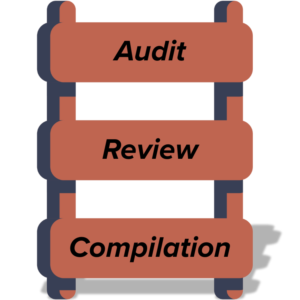
Visualize the range of assurance services offered by a CPA firm as a three-rung ladder. While each rung requires more time and effort to reach than the last, a business is also elevated along the way in terms of its opportunities for growth. Let’s take a look at each of these three services, from least to most extensive.
Compilation and Preparation Engagements – “No Assurance”
Compilation and preparation engagements are the first rung on the “Assurance Service Ladder.” Under these engagements, the CPA firm does little more than take the numbers given to them, assist with some adjusting and clean-up entries (to varying degrees depending on the specifics of the arrangement), and help prepare and present the financial statements and footnotes in a professionally acceptable manner. As a result, No Assurance is offered as to the accuracy or reliability of the numbers and the CPA’s report expressly notes this. The advantage of a compilation is the relatively low cost and time involvement, as compared to other assurance services. The disadvantage, however, is that a compiled financial statement is rarely acceptable to a third party unless an organization’s degree of potential business with them is considered low level and low risk. Third parties will request a compiled set of financial statements when they simply want to see that a qualified CPA was involved in professionalizing the statements and footnotes.
Review Engagements – “Limited Assurance”
As the second rung on the “Assurance Services Ladder,” the review engagement is the middle ground between a compilation and a full-blown audit. In a review engagement, the CPA firm will analyze and make inquiries regarding financials, projects, and WIP schedules, but stop short of sampling source documents and testing internal controls. As a result, the objective of a Review engagement is Limited Assurance as to the accuracy and reliability of the financial statements.
The advantage of a Review engagement is that it will open the door to certain projects, borrowing levels, and bonding capacity, without requiring the time or cost investment of an audit. Third parties will request Reviewed financial statements when they want to see that an independent CPA has at least “kicked the tires” on the financial statements.
Audit Engagements – “Reasonable Assurance”
Audit engagements offer the highest level of assurance that a CPA firm can offer under professional standards: Reasonable Assurance that the financial statements can be relied upon for drawing financial conclusions about the company. During an audit, a CPA firm will test samples of source documents, company processes, and internal controls to the degrees deemed sufficient for opining on the financial statements. Thus, for AEC firms, the audit process will typically involve detailed testing of contract documents and WIP schedules, as well as inquiries of project managers. The jump from Review to Audit in terms of the overall time commitment from an organization’s team is often greater than the jump from Compilation to Review.
A third party will request Audited financial statements whenever they consider the magnitude of an organization’s potential transaction(s) with them (and thus the risk of loss due to inaccurate financial data) to be significant. The downside of an audit is obviously the cost and time commitment associated with the process. The upside is the confidence that an organization’s financial statements possess the highest level of assurance that a third party can possibly request, and therefore, there are additional growth opportunities created for that organization. The detailed level of understanding of a business that a CPA firm needs to attain in order to perform an audit also positions that business to receive higher quality advice from the CPA firm on a range of topics, including tax strategy, cybersecurity, and internal controls.
How Can I Make the Right Choice for My Business?
The distinct levels of assurance, cost, and time commitment highlight the importance of planning and communication when determining the right fit. Since there are no uniform thresholds applicable to all third parties for triggering one level of service vs. another, it is critical to be open with one’s banking and bonding relationships about one’s business plans. If planning to expand into new types of projects, geographic areas, or simply grow in general, knowledge of how these impact financial statement requirements will help a business avoid surprises along the way.
At McKonly & Asbury, we are blessed to work with AEC clients that span the entire “Assurance Services Ladder.” If you have any questions about which service might be best for you, don’t hesitate to contact a member of the AEC team. For more information about McKonly & Asbury’s Architecture, Engineering, and Construction (AEC) experience, visit the AEC Industry Page.
About the Author

Tim Showers, CPA is a leader within our Architecture, Engineering, and Construction (AEC) practice, serving clients across the Mid-Atlantic.… Read more